How the Italian Stock Exchange Works: A Beginner's Guide (2026)
"Where do I go to buy Italian stocks?" "Is Borsa Italiana still Italian?" "What time does it open?" "What's Euronext Milan — my broker keeps showing it?"
These are the questions an Italian beginner asks before their first trade. The answers are less intuitive than they might seem, because over the last fifteen years the Italian market has changed ownership twice and segment names several times.
This article lays out everything you need to know to operate on Borsa Italiana in 2026: who owns it, what trades where, when each market opens, who regulates it, how retail investors actually reach it, and what changes with T+1 in October 2027.
One thing, many names
Borsa Italiana S.p.A. is the company that runs the market — Milan headquarters, 200+ years of history (founded 1808 as the Borsa di Commercio di Milano).
Today it operates under a European parent:
- 2007 to 2021: part of the London Stock Exchange Group (LSEG).
- From April 2021: part of Euronext N.V., which bought it for ~€4.4 billion. Euronext is the pan-European group that also runs the exchanges of Paris, Amsterdam, Brussels, Lisbon, Dublin, and Oslo.
What changes for the retail investor? Little, directly. The main equity market is now called "Euronext Milan" instead of the old "MTA" (Mercato Telematico Azionario). Oversight remains Italian (Consob), listing rules remain Italian, tax remains Italian (26% capital gains + 0.20% Tobin Tax). What changes is the underlying technical infrastructure — integrated with the other Euronext markets — but that's transparent to anyone using a broker.
"Piazza Affari" is the Italian colloquial name for Borsa Italiana. Not a different market; just the Italian way of naming it (from Piazza degli Affari, the Milan square where it sits).
What trades where
Borsa Italiana isn't a single market: it's a group of markets with their own rules and hours.
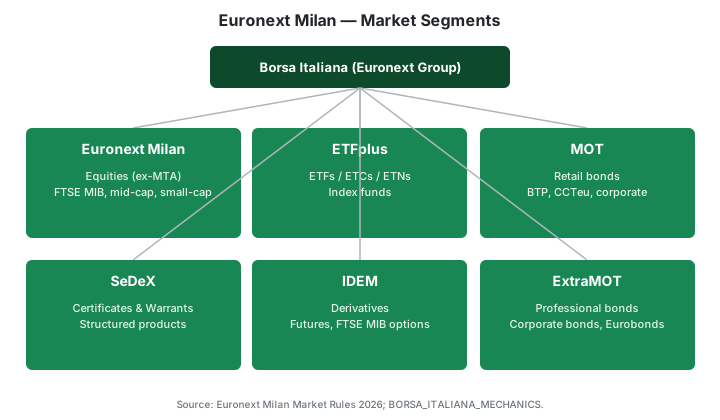
| Market | What trades here | Retail? |
|---|---|---|
| Euronext Milan | Italian stocks (40 blue chips + mid/small cap + STAR) | ✓ |
| Euronext Growth Milan (ex-AIM) | High-growth small caps with lighter rules | ⚠ (low liquidity) |
| ETFplus | All ETFs, ETCs, ETNs listed in Italy (~1,500 instruments) | ✓ |
| MOT | Italian bonds (BTP, BOT, CCTeu) + corporate + foreign | ✓ |
| SeDeX (now Cert-X) | Certificates, covered warrants (structured products) | ⚠ (complex) |
| IDEM | Futures + options on FTSE MIB and single names | ✗ (professional) |
| ExtraMOT | Institutional bonds | ✗ (qualified only) |
The practical point for beginners: 95% of retail investors operate on two markets — Euronext Milan (for individual stocks) and ETFplus (for ETFs). MOT is accessible and important if you buy BTP (see our tax article for why 12.5% tax instead of 26%). Everything else is niche or professional.
Inside Euronext Milan: the segments
Stocks listed on Euronext Milan aren't all equal. They're ordered by market cap:
- FTSE MIB: the top 40 by cap. Blue chips. The main Italian index, rebalanced quarterly (March, June, September, December).
- FTSE Italia Mid Cap: ranks 41–100.
- FTSE Italia Small Cap: ranks 101–180 roughly.
- STAR: opt-in segment for mid/small caps that commit to stricter governance standards — quarterly reporting (vs semi-annual), minimum free float 35% (vs 25%), remuneration + audit committees with independent majority. Companies like Reply, Interpump, Cembre, Tamburi participate in STAR. The visibility premium is real; if free float drops below 35%, they're demoted to the normal segment.
2026 trading hours
The most frequent beginner question: "what time can I buy an Italian stock?" It depends on the market.
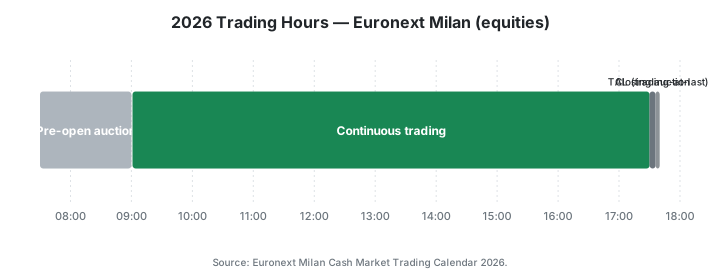
Euronext Milan (stocks) — what most retail investors use:
- 07:30–09:00:59 — Pre-opening. Order collection, no execution.
- 09:01 — Opening auction. Single price crosses all accumulated orders.
- 09:01–17:30 — Continuous trading. The bulk of the day.
- 17:30–17:35:59 — Closing auction. Final price.
- 17:36–17:40 — TAL (Trading-at-Last). Closing-price trades only.
Other markets have slightly different hours — ETFplus opens at 09:04 (three minutes later), SeDeX at 09:05, IDEM (derivatives) runs a much longer day 08:01–22:00.
2026 calendar — when the exchange is closed
Full-closure days:
- January 1 (New Year's)
- April 6 (Easter Monday)
- May 1 (Labour Day)
- December 25 (Christmas)
- December 26 (Saint Stephen)
Early-close days (close at 14:00):
- December 24 (Christmas Eve)
- December 31 (New Year's Eve)
August 15 (Ferragosto) is a normal trading day — the exchange is open, despite being an Italian public holiday. Borsa Italiana follows the common Euronext calendar, not the Italian one. Intraday traders in August often get confused — the market operates normally.
How you get there: the order path
You can't access the trading book directly. You need an authorized intermediary.
You (retail investor)
    │ 1. Order via broker app (web/mobile)
    ▼
Intermediary (SIM / bank / foreign broker)
    │ 2. Order routed (best execution across venues)
    ▼
Euronext Milan order book
    │ 3. Matching
    ▼
Monte Titoli (central depository)
    │ 4. Settlement at T+2 (T+1 from October 2027)
    ▼
Your securities account
The intermediaries (in typical retail popularity order):
- ETF/stock-dedicated SIMs — Directa, Fineco (their PAC/investing service), IWBank. Italian institutions, Consob-regulated, handle taxes automatically (sostituto d'imposta).
- Zero-commission mobile brokers — Trade Republic (Germany-regulated), operating in Italy. They also handle Italian taxes if they operate under Italian licensure.
- Traditional banks — Intesa Sanpaolo, UniCredit via their direct channels. More expensive (€5-12 per trade), but have the familiarity advantage for those who want everything under one roof.
- Foreign brokers — Degiro, Interactive Brokers. Operate in declarative regime: you file Quadro RT in your Modello Redditi PF every year. More work, but global zainetto (see tax article).
The broker cost comparison is the single most impactful factor on terminal wealth for a 20-year PAC — we did the math in our PAC article: the gap between a zero-commission broker and a traditional bank at €12/trade is ~€6,800 over 20 years on a €200/month PAC.
Settlement: T+2 today, T+1 from October 11, 2027
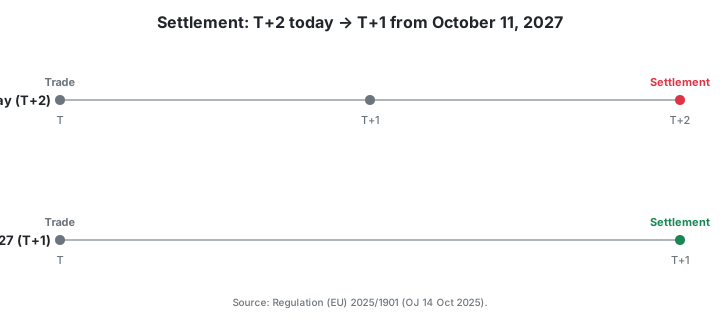
When you make a trade today, the security and cash effectively exchange hands two business days later — the so-called T+2. If you buy a stock Friday, it actually appears in your securities account on the following Tuesday (weekend in the middle).
This is changing. On October 11, 2027 the European Union moves to T+1 — one business day between trade and settlement. The regulation was adopted by EU co-legislators and published in the EU Official Journal on October 14, 2025. The UK and Switzerland align on the same date.
Global context: The US moved to T+1 in May 2024. Canada, Mexico, India are already T+1. Europe is closing the trans-Atlantic gap.
What changes for you: almost nothing operationally. Practical meaning: if you sell Friday afternoon, today cash arrives Wednesday (T+2 + weekend); after October 2027 it arrives Monday. Faster access to cash after a sale. For automatic PAC investors, occasional traders, or buy-and-hold strategies, nothing visible changes. For intraday traders, it shortens the "suspended phase" between sale and cash availability.
Who regulates it: Consob, OCF, Banca d'Italia
Three authorities with complementary roles:
- Consob — Commissione Nazionale per le Società e la Borsa. Authorizes listings, supervises markets, enforces anti-abuse rules (insider trading, manipulation), oversees intermediaries. It's the "market" regulator.
- OCF — Organismo di vigilanza e tenuta dell'Albo unico dei Consulenti Finanziari. Maintains the register of qualified financial advisors. Since 2018 it replaced Consob in the role of keeping the register (previously it was directly "Consob's register").
- Banca d'Italia — supervises banks, and shares some powers over integrated bank-intermediaries (e.g., a bank that is also a SIM).
The underlying regulatory framework is TUF — Testo Unico della Finanza, D.Lgs. 58/1998, and its implementing regulations (Intermediaries Regulation, Issuers Regulation, Markets Regulation).
Common recurring confusions
- "Nasdaq" isn't an Italian market. Some apps show Apple or Microsoft — those trade on Nasdaq (US) or NYSE (US), not Borsa Italiana. Your broker routes to the correct market, but Italian tax (26% capital gains) still applies if you're an Italian tax resident.
- "Borsa di Milano" vs "Borsa Italiana" vs "Euronext Milan" — they're synonyms for the same entity. Euronext Milan is the technical current name of the main equity market since 2021; "Borsa Italiana" is the operator; "Piazza Affari" is colloquial.
- Italian stocks also listed elsewhere — some Italian blue chips (Ferrari, Stellantis) have dual listings in New York (NYSE) or Amsterdam. You can buy them either on .MI or the other market; liquidity is typically higher outside Italy for these specific names, but Italian tax still applies for Italian residents.
- "Sostituto d'imposta" vs "declarative regime" — this isn't about the market, it's about the intermediary. See the tax article.
For anyone getting started
The minimal path to the first Borsa Italiana trade:
- Open an account with a low-cost intermediary (category: ETF-focused SIM or zero-commission mobile broker).
- Verify the tax regime (sostituto d'imposta = zero paperwork for you; declarative = you'll need to file Quadro RT).
- Choose an instrument — for beginners, a globally diversified ETF is the literature-recommended starting point (see our ETF article).
- Learn the hours — orders placed outside market hours accumulate and execute at the next open. No harm, but don't expect immediate execution if you send an order at 22:00.
- Understand settlement — the security isn't "yours" until T+2 (today) / T+1 (after October 2027). Fine-tuning that rarely matters for buy-and-hold.
Further reading
Internal references:
- What is an ETF — to choose the typical instrument for a first portfolio
- Dollar-Cost Averaging in Italy — so you don't have to pick the right entry moment
- Italian Capital Gains Tax — to understand how much the state withholds
- 10 Beginner Mistakes — mistake #5 specifically on Italian concentration
Authoritative external sources:
- Borsa Italiana — official site with updated calendars and hours
- Consob — investor portal with free educational guides
- EU Commission — Shorter Settlement Cycle for the T+1 regulatory detail
This article reflects trading hours, segment structure, regulatory setup, and the European settlement framework as of May 18, 2026. Borsa Italiana publishes calendar updates before the start of each year — always check the official site for the current year.
Sources last verified: 2026-05-18. Legal references and authorities (Agenzia delle Entrate, MEF, TUIR) cited in the article body.
Educational tool, not personalized financial advice. Fanta Finanza is not OCF-registered — details here.